
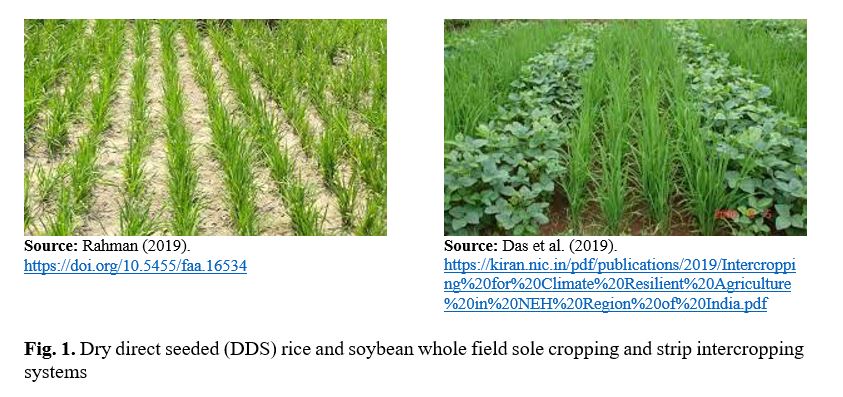
Worldwide automating agroecology has been advocated to achieve the intercropping agronomic and ecological synergies, e.g., in the large-scale farming of the United States (Ward et al., 2016), and medium scale farming in the European Union (Ditzler and Driessen, 2022) and United Kingdom (Al-Amin et al., 2023; Hands Free Farm, 2023, 2024). Research suggested within field heterogeneous mixed cropping systems, like strip intercropping (Ghaffarzadeh et al., 1994; Verdelli et al., 2012), pixel cropping (Ditzler & Driessen, 2022), and relay intercropping (Patel, 2020; Tanveer et al., 2017). Complex intercropping mechanized farm management found challenging even with smart autonomous machined farming operation (Ditzler & Driessen, 2022). Strip cropping is the simplest intercropping system even with conventional mechanized farming operations with human drivers (Alarcón-Segura et al., 2022; Exner et al., 1999; van Apeldoorn et al., 2020). Here in this study, strip cropping refers to a farming practice of simultaneously growing two or more crops in adjacent strips, where the strips are wide enough for independent cultivation and narrow enough for facilitating crop interaction (Al-Amin et al., 2024; Brooker et al., 2015; Hernández-Ochoa et al., 2022; Vandermeer, 1989).
Although large and medium scale mechanized farming contexts evaluated strip cropping techno-economic and environmental feasibility, smallholder farms (i.e., typically have less than two hectares of land) (Lowder et al., 2016; FAO, 2010) with premature whole farm mechanization like Bangladesh yet to answer intercropping techno-economic and environmental feasibility because of existing labour scarcity, increasing wage rate, and substantially drastic agricultural employment rate than regional peers (Hassan and Kornher, 2022; World Bank, 2021). Historically, Bangladesh adopted mechanized primary and secondary tillage operations with two-wheel machines (2WM), while other operations are still operated with manual labour. However, the supply stakeholders, (e.g., government of Bangladesh, academic and research) advocated whole farm mechanization with human operators and low-cost precision technology (NAMP, 2020; Al-Amin et al., 2024) as well as enterprise diversification with intercropping (NAP, 2018). Nevertheless, the cost-effective and profitable farm management alternatives under on-going on-farm productivity constraints are not yet guided with evidence-based policy suggestions.
The country is yet to explore farm management systems intensification with companion crops irrespective of crop growing seasons because conventional waterlogged puddled rice systems (PRS) are not suitable for with-in field heterogeneous intercropping with strip field layouts. As a practical and sustainable alternative, dry direct-seeded (DDS) rice-based cropping systemscould be the next best farming alternatives to achieve the macro-level agriculture and mechanization visions envisages by the government to achieve food-self-sufficiency. Worldwide, DDS cropping systems has been initiated in countries like China (Liu et al., 2015), Philippines, Japan (Kanno et al., 2023), Vietnam (Malabayabas et al., 2014), United States, Australia, and Europe (Shekhawat et al., 2020). Like other countries, Bangladesh has been trying scaling up DDS cropping systems to combat on-farm productivity constraints related to water and labour scarcity (Ahmed et al., 2015, Matloob et al., 2015). However, DDS rice based cropping systems still facing agronomic challenges for instance, higher weed infestation (Ahmed et al., 2014) that led to yield penalty (Rahman et al., 2019; Rahman et al., 2020). But DDS cropping systems have environmental promises including lower emissions of greenhouse gases (Bhatt et al., 2023), early maturity, lower irrigation (Rahman et al., 2023; Rahman and Uddin, 2020; Alam et al., 2018). To maximize the production goals of productivity and profitability, and environmental goal of limiting environmental footprints, as well as to guide future natural experiments, countries like Bangladesh need to answer the economics of evolutionary mechanization under DDS cropping systems. To limit the research gaps, this study assesses the economics of DDS cropping systems under whole field sole cropping and strip intercropping systems operated with various human operated mechanization scenarios and low-cost retrofitted autonomous systems.